
Marvelous Spatuletail Hummingbird: Facts & Where to See It
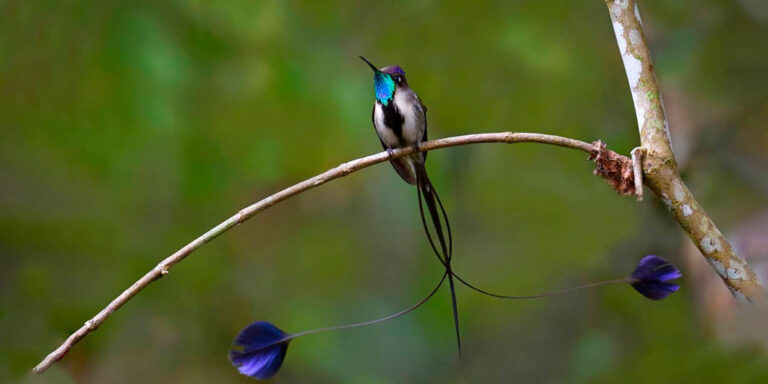
The marvelous spatuletail (Loddigesia mirabilis), also spelled marvellous spatuletail and called colibrí cola de espátula in Spanish, is a hummingbird that lives only in the Utcubamba River valley of northern Peru, in cloud forest at about 2,100–2,900 m (7,000–9,500 ft). The male has just four tail feathers, and the outer two end in large violet-blue discs, the “spatules”. It is Near Threatened on the IUCN Red List and Endangered under Peruvian law. The easiest place to see it is the Huembo reserve, near Pomacochas in the Amazonas region, where it comes to the feeders.
Marvelous spatuletail facts at a glance
| Scientific name | Loddigesia mirabilis, first described in 1835 |
|---|---|
| Other names | Marvellous spatuletail, spatuletail hummingbird; colibrí cola de espátula in Spanish |
| Range | Only the Utcubamba River valley, northern Peru (Amazonas region) |
| Elevation | About 2,100–2,900 m (7,000–9,500 ft) |
| Habitat | Open areas and the edges of older cloud forest, often on steep slopes |
| Diet | Nectar from at least five plant species; it also visits feeders |
| Male’s tail | Only four feathers; the outer two are long, wire-like shafts ending in violet-blue discs, three or four times the length of the body |
| Female’s tail | Almost as long as her body, with much smaller spatules |
| Population | 1,000–2,500 birds and decreasing (American Bird Conservancy) |
| Status | Near Threatened (IUCN Red List); Endangered in Peru (D.S. 004-2014-MINAGRI) |
Where does the marvelous spatuletail live?
The American Bird Conservancy describes its range as extremely restricted: the species lives only in the valley of the Utcubamba River in northern Peru, between about 2,100 and 2,900 m (7,000 and 9,500 ft). It uses open areas in the Andean cloud forest, often on steep ground, and is seen most often along the edges of older forest.
It feeds only on nectar and has been recorded at the flowers of at least five plant species; some observers think it prefers Bomarea formosissima. It also comes to hummingbird feeders, which is why the feeders at Huembo are the most reliable place to watch it.
The male’s tail and courtship display
No other hummingbird has a tail like the male’s. It has only four feathers. The two outer ones grow into long, bare, wire-like shafts that end in large violet-blue discs, the spatules, and together they reach three or four times the length of the bird’s body.
Males display to females at leks. A male bounces back and forth across a horizontal twig at high speed, then hovers in front of the female while waving his spatules, with snapping and chittering sounds. Depending on the season, our groups can watch this display at Huembo.
The female lacks the male’s long rackets. Her outer tail feathers are still long, almost as long as her body, and end in much smaller spatules.
Is the marvelous spatuletail endangered?
The IUCN Red List classifies it as Near Threatened, and the American Bird Conservancy estimates 1,000–2,500 birds with a decreasing population. In Peru it is listed as Endangered (EN) in the official list of threatened wildlife, Supreme Decree 004-2014-MINAGRI, published in El Peruano on 8 April 2014; the decree bans hunting, capturing, keeping, selling, transporting or exporting it for commercial purposes.
The main threat is the loss of its habitat: much of the forest inside its small range has been destroyed since 1978, cleared by burning for farming and by illegal logging.
It is not Peru’s national bird. That is the Andean cock-of-the-rock, a different species that our groups see in the Manu cloud forest.
Where to see the marvelous spatuletail: Huembo
In 2006 the American Bird Conservancy and the Peruvian NGO ECOAN, together with the local Pomacochas community, created the Huembo conservation easement, the first protected area for the marvelous spatuletail. They also built an ecolodge with hummingbird feeders, where the spatuletail comes to feed alongside many other hummingbirds. Huembo is near the town of Pomacochas, on the road between Jaén and Abra Patricia in the Amazonas region.
Three of our birding tours stop at Huembo:
| Tour | Time at Huembo | Price per person |
|---|---|---|
| Northern Peru Birding Tour, 16 days | Days 5 and 6: first visit to the feeders, then an afternoon at the reserve; night in Pomacochas | From $2,500 |
| Peru Hummingbird Photo Tour, 15 days | Days 3 and 4: arrival on day 3 and a full morning on day 4; night at Huembo Ecolodge | From $3,200 |
| Northern Peru Birding Tour, 10 days | Day 6: the Huembo feeders after the morning at San Lorenzo | From $3,500 |
Sources
- American Bird Conservancy: Marvelous Spatuletail (range, elevation, habitat, diet, tail, display, IUCN status, population, threats, Huembo)
- El Peruano, 8 April 2014: Supreme Decree 004-2014-MINAGRI and its annex (PDF) (Loddigesia mirabilis, no. 123, Endangered; article 3)
- Itineraries of our northern Peru tours of 10, 15 and 16 days
Updated November 2026.
Tours that stop at Huembo for the spatuletail
These northern Peru trips visit the Huembo reserve, where the marvelous spatuletail comes to the feeders.
Frequently asked questions
Where does the marvelous spatuletail live?
Only in the Utcubamba River valley of northern Peru, in the Amazonas region, at about 2,100–2,900 m (7,000–9,500 ft). It uses open areas and the edges of older cloud forest, often on steep slopes.
How many tail feathers does the marvelous spatuletail have?
The male has only four. The two outer ones are long, wire-like shafts that end in violet-blue discs, the spatules, and reach three or four times the length of the body.
What does the female marvelous spatuletail look like?
She does not have the male's long rackets. Her outer tail feathers are almost as long as her body and end in much smaller spatules.
How does the male spatuletail court the female?
At a lek, the male bounces back and forth across a horizontal twig at high speed, then hovers in front of the female waving his spatules, with snapping and chittering sounds.
Is the marvelous spatuletail endangered?
The IUCN Red List classifies it as Near Threatened, with 1,000–2,500 birds and a decreasing population according to the American Bird Conservancy. In Peru it is officially Endangered (Supreme Decree 004-2014-MINAGRI). Its main threat is the loss of its forest to burning and illegal logging.
Where can I see the marvelous spatuletail?
At the Huembo reserve near Pomacochas, in the Amazonas region, where it comes to the hummingbird feeders. Our 16-day northern Peru birding tour, 15-day hummingbird photo tour and 10-day northern Peru tour all stop there.